One Health and Development Initiative (OHDI) is a nonprofit organization advancing One Health through integrated programmes in public health, animal health and welfare, sustainable food systems, environmental conservation, antimicrobial resistance (AMR), health security, research, innovation, policy, and capacity strengthening across Africa.
The Africa Fish & Aquaculture Welfare (AFIWEL) Programme is OHDI’s flagship programme for advancing fish welfare and promoting responsible and sustainable aquaculture systems across Africa. Through the AFIWEL Program, OHDI works with governments, farmers, fisheries and veterinary institutions, researchers, private-sector actors, and other stakeholders to integrate fish welfare with aquatic animal health, biosecurity, responsible production, capacity strengthening, data and digital systems, market-based approaches, and other interventions aimed at advancing healthier, more welfare-conscious, productive, and sustainable aquaculture systems.
OHDI also supports the development and implementation of fish welfare policies, guidelines and standards; capacity strengthening for farmers, inspectors, veterinarians and other value-chain actors; farm-level improvement and verification; research and data generation; digital solutions; and private-sector and market engagement.
Position Summary
The Programme Coordinator will be responsible for translating OHDI’s goals and objectives to advance responsible and sustainable aquaculture in Nigeria. The role will support the rollout and practical application of fish welfare guidelines and responsible aquaculture practices; capacity strengthening for farmers, government officials, inspectors, and other value-chain actors; public- and private-sector partnerships; farm improvement and verification; digital solutions and data systems; market access opportunities; and programme monitoring, research, and learning across priority aquaculture-producing states.
The successful candidate will be expected to work with a high degree of initiative, ownership, and independence, identifying opportunities, developing implementation pathways, engaging stakeholders confidently, coordinating multiple workstreams, supervising junior programme personnel, addressing implementation challenges, and ensuring that activities progress from planning to measurable outcomes for fish welfare and responsible, sustainable aquaculture.
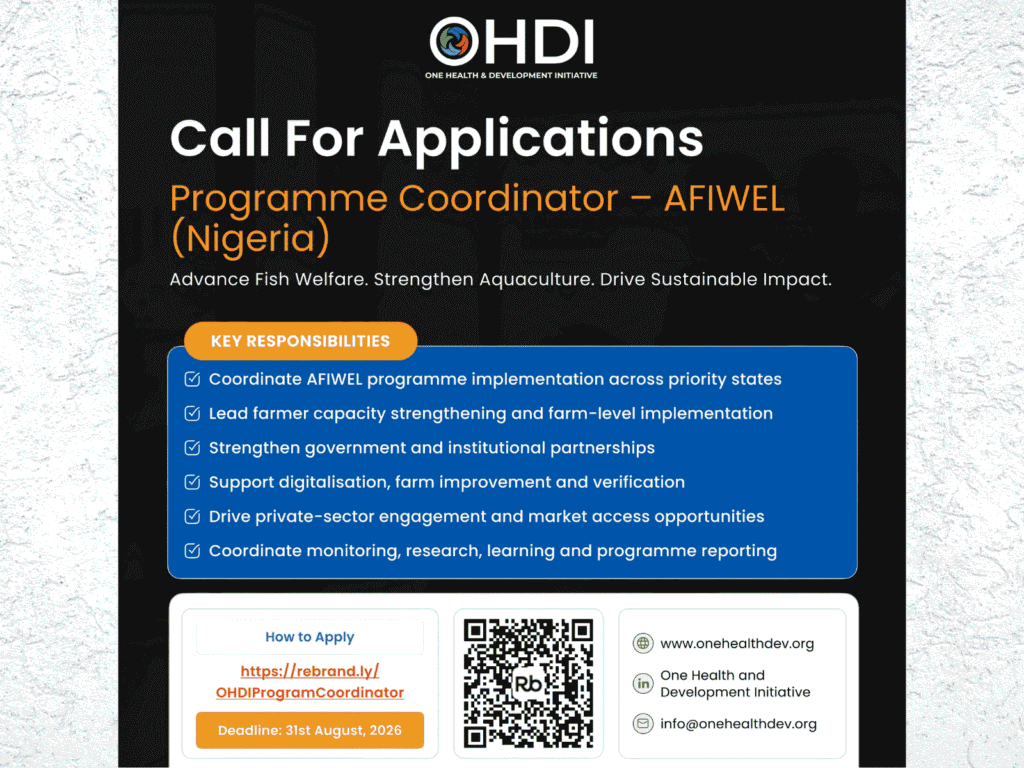
Key Responsibilities
The successful candidate will provide leadership and coordination across the following areas:
1. Programme Coordination and Implementation
- Coordinate day-to-day implementation and expansion of the AFIWEL Programme across priority states.
- Translate fish welfare guidelines, policies, and programme frameworks into practical state- and farm-level activities.
- Develop and track implementation plans, timelines, deliverables, and stakeholder commitments.
- Identify and prioritise implementation opportunities based on aquaculture production, government readiness, potential impact, and opportunities for sustainable change.
- Identify implementation challenges and develop practical solutions to ensure activities progress to measurable results.
- Promote an integrated One Health approach connecting fish welfare with aquatic animal health, biosecurity, responsible antimicrobial use, food safety, environmental sustainability, and farm productivity.
2. Government, Policy and Institutional Engagement
- Coordinate engagement with federal and state institutions responsible for fisheries, aquaculture, veterinary services, food systems, and related sectors.
- Support the rollout and institutionalisation of state fish welfare guidelines and responsible aquaculture frameworks.
- Work with government partners to integrate fish welfare, health, and responsible production practices into relevant inspection, extension, surveillance, and support systems.
- Coordinate technical working groups, government focal persons, and institutional partnerships.
- Represent OHDI at relevant technical and stakeholder engagements when delegated.
3. Farmer Capacity Strengthening and Farm-Level Implementation
- Coordinate capacity strengthening for fish farmers, farmer associations, fisheries officers, inspectors, extension personnel, and other aquaculture stakeholders.
- Support farms to adopt improved practices relating to fish welfare, health, biosecurity, water quality, responsible production, record-keeping, and farm management.
- Coordinate demonstration activities, implementation pilots, training-of-trainers, and other approaches that facilitate practical adoption and scale-up.
- Identify barriers to adoption and work with farmers, government, and technical partners to develop context-appropriate solutions.
- Promote understanding of the links between fish health and welfare, productivity, food safety, farm performance, and sustainable aquaculture.
4. Digitalisation, Farm Improvement and Data Systems
- Support the integration and appropriate use of OHDI’s digital and implementation tools within AFIWEL activities, including One Farm Records (OFR), RORE, and AgrowSAFE, where relevant.
- Promote improved farm record-keeping, welfare and health monitoring, disease/event reporting, traceability, and data-informed farm management.
- Coordinate farmer onboarding, training, and implementation support for relevant digital tools.
- Support AgrowSAFE assessment, progressive farm improvement, and verification approaches.
- Identify opportunities for digital systems to strengthen inspection, surveillance, farmer support, and programme monitoring.
5. Private-Sector Engagement and Market Access
- Build relationships with aquaculture businesses, hatcheries, feed companies, processors, retailers, buyers, aggregators, and other value-chain actors.
- Develop partnerships and market-based approaches that incentivise improved fish welfare and responsible aquaculture practices.
- Support linkages between participating farmers and responsible buyers, processors, and markets.
- Explore buyer commitments, responsible sourcing, farmer incentives, and other mechanisms that can accelerate adoption of improved practices.
- Support participating farms to progress towards appropriate verification, market-readiness, and responsible production benchmarks.
6. Monitoring, Research, Learning and Impact
- Work with OHDI’s MEAL and Research & Policy teams to monitor implementation progress and assess changes in farm practices and outcomes.
- Track key programme results, including states and institutions engaged, farmers and farms reached, implementation of guidelines, adoption of improved practices, private-sector participation, and estimated numbers of fish positively affected.
- Support baseline studies, implementation research, field data collection, and other evidence-generation activities.
- Identify lessons, implementation barriers, and successful approaches to strengthen programme delivery.
- Contribute to technical reports, case studies, learning products, donor reporting, and dissemination of programme evidence.
7. Team, Programme Management and Reporting
- Supervise and mentor assigned AFIWEL Programme Officer(s), field personnel, and other implementation support staff.
- Coordinate workplans, delegation, activity delivery, and routine progress reviews.
- Maintain programme trackers, documentation, stakeholder records, and implementation reports.
- Support budget planning and monitoring and ensure activities comply with organisational and donor requirements.
- Collaborate with OHDI’s programme, policy, research, MEAL, communications, finance, and operations teams.
- Support documentation and communication of programme achievements, implementation milestones, and impact.
Expected Results
The Programme Coordinator will contribute to:
- Effective implementation and expansion of the AFIWEL across priority Nigerian states.
- Translation of fish welfare guidelines and related frameworks into practical government and farm-level implementation.
- Increased capacity and adoption of improved fish health, welfare, biosecurity, and responsible aquaculture practices.
- Stronger government ownership and integration of fish welfare and responsible aquaculture within relevant systems and services.
- Increased use of appropriate digital, farm-management, and monitoring tools, including OFR, RORE, and AgrowSAFE where relevant.
- Stronger private-sector engagement, responsible sourcing, farmer incentives, and market-access opportunities.
- Improved programme data and evidence on implementation, farm practices, reach, and numbers of fish potentially affected.
- Development of effective implementation approaches that can be scaled within Nigeria and adapted across other AFIWEL countries.
Qualifications and Experience
Applicants should possess:
- A Bachelor’s degree in Fisheries, Aquaculture, Veterinary Medicine, Animal Science, Marine/Aquatic Sciences, Agriculture, One Health, Development Studies, or a related field.
- A relevant postgraduate qualification is an advantage.
- At least 7 years of relevant professional experience in aquaculture, fisheries, animal health/welfare, agricultural development, food systems, or related programmes.
- Demonstrated experience coordinating programmes involving multiple stakeholders and field-level implementation.
- Experience engaging government institutions, farmers/producer organisations, private-sector actors, and/or development partners.
- Experience coordinating training, workshops, field activities, or capacity-strengthening programmes.
- Experience supervising or coordinating junior staff, field teams, or consultants is desirable.
- Experience within Nigeria’s fisheries or aquaculture sector is a strong advantage.
- Familiarity with One Health, responsible aquaculture, aquatic animal health, fish welfare, digital agriculture, or sustainable food systems is desirable.
Essential Competencies
The successful candidate should demonstrate:
- Initiative and Ownership: Ability to independently identify priorities, develop next steps, and move activities from planning to implementation.
- Programme Coordination and Execution: Strong organisational skills and the ability to manage multiple states, stakeholders, activities, and deadlines while delivering results.
- Stakeholder Engagement: Confidence engaging government officials, farmers, technical professionals, private-sector actors, and institutional partners.
- Problem-Solving and Adaptability: Ability to identify implementation challenges, develop practical solutions, and respond effectively to emerging opportunities.
- Leadership and Teamwork: Ability to supervise and mentor junior staff while collaborating effectively across multidisciplinary teams.
- Communication: Strong written, verbal, reporting, presentation, and stakeholder communication skills.
- Results and Data Orientation: Ability to track implementation progress, use data to inform decisions, and maintain focus on measurable programme outcomes.
- Integrity and Professionalism: Strong judgement, accountability, and respect for organisational policies and institutional processes.
Other Requirements
- Willingness to travel regularly within Nigeria, particularly to programme states and aquaculture production areas.
- Ability to work independently while maintaining effective coordination with the wider OHDI team.
- Strong digital literacy and proficiency with standard productivity and programme-management tools.
- Excellent written and spoken English.
- Knowledge of relevant Nigerian languages is an advantage.
How to Apply
Interested and qualified candidates should complete the online application form and upload the required documents.
Application Deadline: 31st August, 2026
Only shortlisted candidates will be contacted for the next stage of the recruitment process.
Join One Health and Development Initiative in advancing fish welfare, responsible aquaculture, and sustainable food systems across Nigeria and Africa.