Antimicrobial resistance (AMR) is often called a “silent pandemic.” Part of what enables this is bad communication. Too many AMR campaigns are built the same way: a poster, a slogan, a hashtag, and a hope that awareness alone will change behaviour. It rarely does.
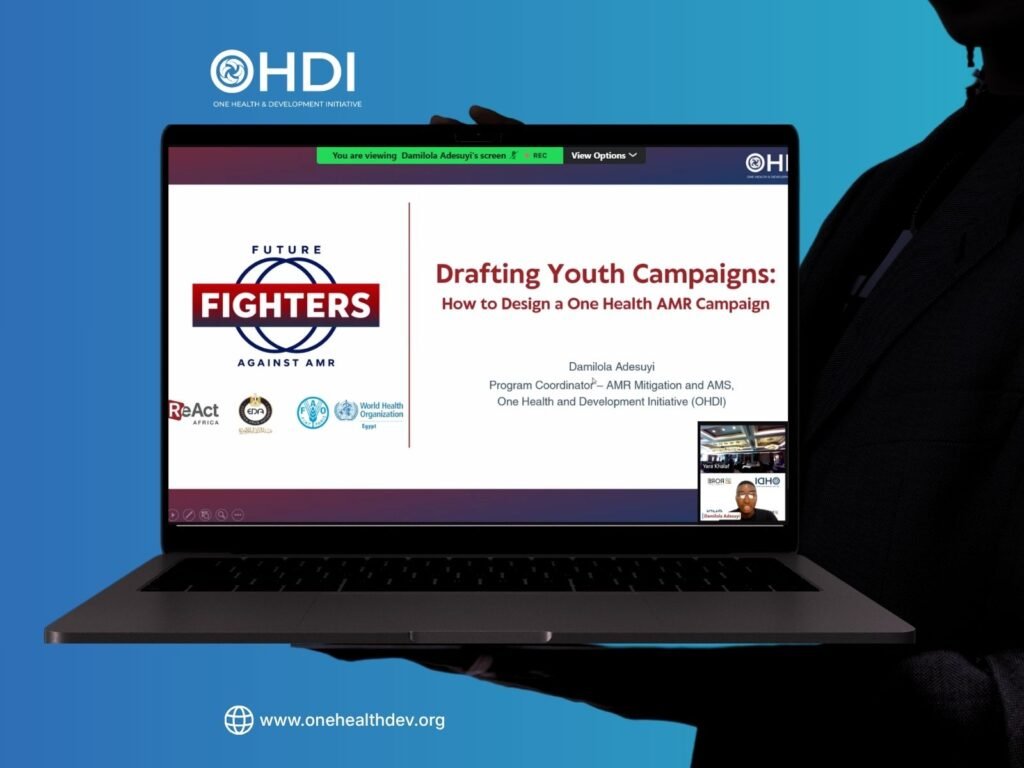
At a recent hybrid training session, “Drafting Youth Campaigns: Interdisciplinary Teams Design a One Health AMR Campaign,” Damilola Adesuyi, Programme Coordinator at One Health and Development Initiative (OHDI), broke down exactly why this happens, and what to do instead. The session was hosted jointly by the Egyptian Drug Authority (EDA), the World Health Organization (WHO), the Food and Agriculture Organization (FAO), and ReAct Africa.
The takeaway was direct: if your AMR campaign isn’t built around real people’s behaviour, it isn’t going to change anything.

Why AMR Campaigns Fail
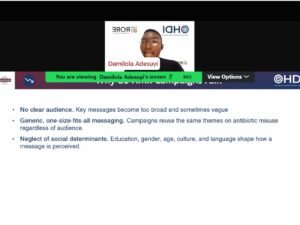
Before designing anything new, Damilola asked participants to look at what goes wrong. The most common reasons:
- No clearly defined target audience: campaigns built for “everyone” end up speaking to no one.
- Generic, one-size-fits-all messaging: the same poster used in a rural clinic and an urban pharmacy rarely works for both.
- Ignoring social and cultural context: education, age, gender, language, access to healthcare, and local norms all shape how a message lands.
- Abstract risk communication: “resistance is rising” means little without a tangible, personal stake.
- Heavy technical jargon: terms that only make sense to researchers often confuse, or alienate, the public.
The fix isn’t more information. It’s better-targeted information, delivered through trusted voices, with a clear and doable action attached.
What Actually Works: The Building Blocks of Effective AMR Messaging
He outlined the ingredients of campaigns that move the needle:
- Audience-specific messaging tailored to who is actually being reached
- Cultural and social relevance, reflecting the community’s own language and norms
- Clear, actionable requests, not “be aware,” but “do this specific thing”
- Memorable, relatable framing instead of clinical language
- Community ownership, built with the people the campaign is meant to serve
- Trusted messengers: local leaders and influencers carry more weight than institutions ever will
The Psychology of Behaviour Change: COM-B and the Stages of Change
The COM-B Model
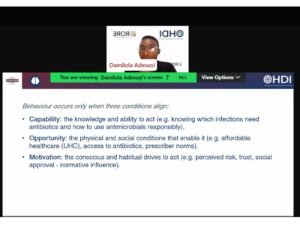
A recurring theme of the session was that AMR misuse and abuse (over-the-counter antibiotic purchases, incomplete treatment courses, antibiotic use in livestock without veterinary guidance) is rarely a knowledge problem alone. To explain this, Adesuyi introduced the COM-B model, which breaks behaviour down into three interacting drivers:
- Capability: Does the person have the knowledge and skills to act differently?
- Opportunity: Do their social and physical environment actually allow it (affordable healthcare access, supportive norms among peers and professionals)?
- Motivation: What conscious and subconscious forces are at play, such as perceived risk, peer pressure, and trust in whoever is delivering the message?
A campaign that only targets capability (i.e., “here’s a flyer”) while ignoring opportunity and motivation is set up to limited success.
The Transtheoretical Model (Stages of Change)
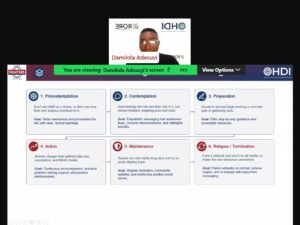
The session also applied the Transtheoretical Model, which maps behaviour change across six stages: pre-contemplation, contemplation, preparation, action, maintenance and relapse/termination. Relapse isn’t treated as failure; it’s a normal part of the cycle, and a chance to identify barriers and re-engage.
The lesson for campaign designers: behaviour change is a process, not an event. A single flyer or awareness week won’t cut it. Sustained communication, follow-up, and reinforcement are what make change stick.
A Practical Framework: The WHO Tailoring Approach
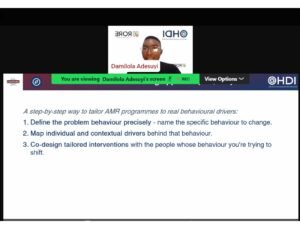
Damilola Adesuyi walked participants through a step-by-step model for building a campaign from the ground up:
- Identify the specific behaviour you want to change (e.g., completing a full antibiotic course, or avoiding antibiotic use in livestock without veterinary oversight).
- Investigate the drivers: the individual, social, and contextual factors behind that behaviour.
- Co-design with the community, through workshops, focus group discussions, and key informant interviews, rather than designing for people in isolation.
- Test, implement, and evaluate the intervention.
- Refine and adapt based on what the findings/ evidence shows.
This is fundamentally different from the common “create poster, distribute poster, hope for the best” model that dominates so much public health messaging.
Why AMR Needs a One Health Lens
Antimicrobial resistance doesn’t respect or care about the boundaries between humans, animals, and the environment; resistant pathogens move freely between all three. That’s why the session emphasized building multidisciplinary campaign teams, bringing together clinicians, veterinarians, environmental scientists, and behavioural scientists.
Treating AMR as “just a medical issue” misses the pathways that actually drive resistance, from antibiotic runoff in wastewater to overuse in livestock production. A genuine One Health approach means every campaign accounts for these interconnected drivers from the start.
Key Takeaways for Campaign Designers
An effective AMR campaign is:
- Audience-centred: built around a specific group, not “the general public”
- Culturally relevant: shaped by local language, norms, and trusted messengers
- Behaviour-focused: grounded in models like COM-B, not just information delivery
- Actionable: offering one clear, doable behaviour, not a list of warnings
- Continuously evaluated: refined through real feedback, not launched and forgotten
- Multidisciplinary: reflecting the true One Health nature of antimicrobial resistance
As antimicrobial resistance continues to grow as a global health threat, sessions like this one highlight a critical shift. The future of AMR communication isn’t about shouting louder. It’s about listening better, designing smarter, and working across disciplines to make behaviour change genuinely achievable.