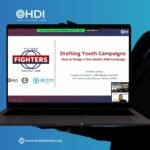
When Damilola Adesuyi logged on to present at the 9th World One Health Congress (WOHC 2026) in Lisbon, Portugal, he wasn’t just sharing a poster, he was telling the story of hundreds of young people across three countries who decided that antimicrobial resistance (AMR) was a fight worth showing up for.
Held from 4 – 7 September 2026 and bringing together researchers, policymakers, and health practitioners from across the globe, WOHC 2026 dedicated an entire scientific track to antimicrobial resistance. It was here, in front of an international audience, that the Stop Superbugs Squad’s flagship initiative, Youths for AMR Communication and Action (YARC) earned its place among the world’s leading One Health conversations.
The Problem YARC Set Out to Solve
In many communities, misinformation and limited awareness around antimicrobial resistance keep driving the misuse of antibiotics and with it, the rise of superbugs that no longer respond to treatment. YARC was built with the conviction that young people, trained and equipped, can become trusted messengers who change how their communities understand and respond to AMR.
Designed around World Antimicrobial Awareness Week (WAAW) 2024 and beyond, YARC unfolded through two coordinated cohorts, each tackling the challenge from a different angle.
Cohort 1: African Youths for AMR Communication
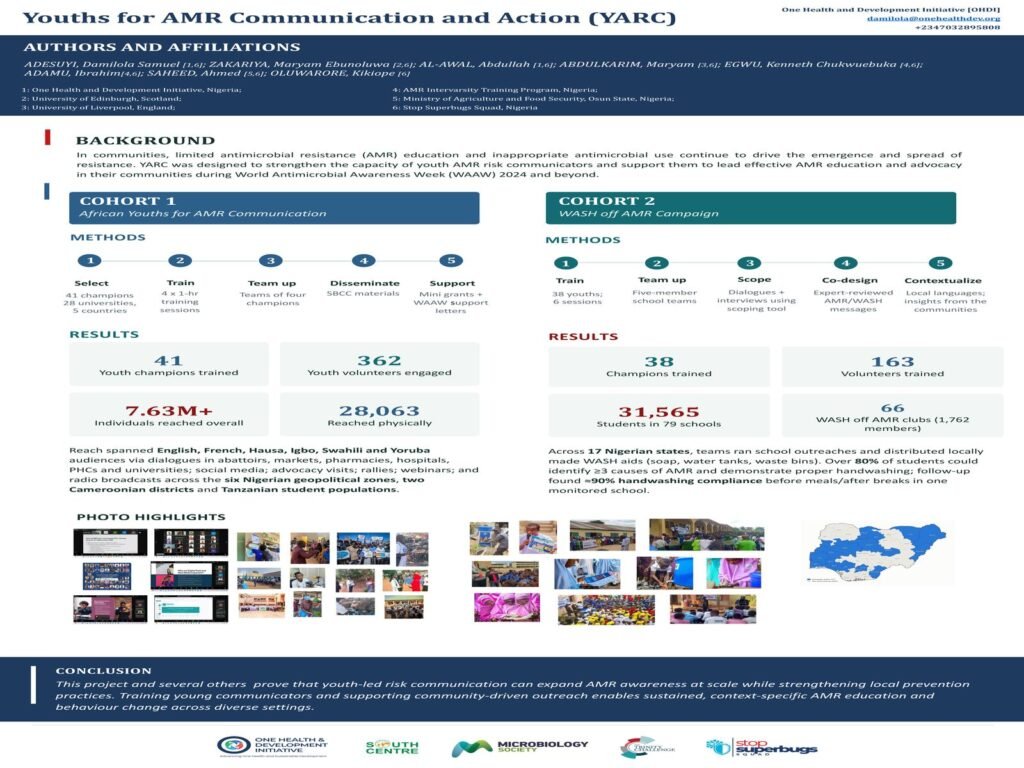
This cohort selected and trained 41 youth champions from 28 universities across 5 countries, forming them into small teams to disseminate social and behaviour change communication (SBC) materials, backed by mini-grants and official WAAW support letters.
The results achieved were:
- 41 youth champions trained
- 362 youth volunteers engaged
- 7.63 million individuals reached
- 28,063 people reached physically
What makes this even more remarkable is the reach: messages disseminated in English, French, Hausa, Igbo, Swahili, and Yoruba languages, delivered through dialogues in abattoirs, markets, pharmacies, hospitals, and universities, as well as social media, advocacy visits, rallies, webinars, and radio spanning all six Nigerian geopolitical zones, two districts in Cameroon, and student populations in Tanzania.
Cohort 2: WASH off AMR Campaign
The second cohort took a hands-on, school-based approach: training youths, forming school teams, scoping community needs, co-designing expert-reviewed AMR and WASH (Water, Sanitation and Hygiene) messages, and contextualizing them in local languages.
The impact was:
- 38 champions trained and 163 volunteers trained
- 31,565 students reached across 79 schools
- 66 WASH-off AMR clubs formed, with 1,762 members
Across 17 Nigerian states, teams distributed locally made WASH aids; soap, water tanks, and waste bins alongside school outreaches. Over 80% of students could name at least three causes of AMR and demonstrate correct handwashing, and one monitored school recorded ~90% handwashing compliance before meals and after breaks in follow-up visits.
Why This Matters
AMR doesn’t respect borders, and neither does effective communication about it. What YARC demonstrates and what resonated with the WOHC 2026 audience is that youth-led, community-rooted, culturally contextualized outreach can shift knowledge and behaviour at scale, often more effectively than top-down campaigns. It is proof that the fight against superbugs can be led from the ground up.
Presenting this work on an international platform like WOHC gives the project and the young people behind it greater visibility that can open doors to new partnerships, funding, and policy attention for youth-driven AMR work across Africa and beyond.
The People Behind the Poster
This work was made possible by a dedicated team: Damilola Adesuyi, Maryam Ebunoluwa Zakariya, Abdullah Al-Awal, Maryam Abdulkarim, Kenneth Chukwuebuka Egwu, Ibrahim Adamu, and Ahmed Saheed representing the One Health and Development Initiative, the University of Edinburgh, the University of Liverpool, the AMR Intervarsity Training Program, the Ministry of Agriculture and Food Security (Osun State), and the Stop Superbugs Squad, supported by consultants including Dr. Kikiope Oluwarore.
We also extend our sincere appreciation to our partners and supporters whose backing made this project possible, including the South Centre, the Microbiology Society, and The Trinity Challenge. Their continued investment in youth-led, community-driven public health work is what turns ideas like YARC into measurable, lasting impact.
Looking Ahead
YARC is a reminder that the next generation isn’t waiting to be handed a seat at the table, they are building the table by training their peers, and taking the message of antimicrobial resistance directly to the people who need to hear it. As Damilola and the Stop Superbugs Squad carry this story to global stages like WOHC 2026, One Health and Development Initiative remains proud to support and champion this work and excited for what these young changemakers will do next.