One Health and Development Initiative (OHDI) is proud to support the OAU 2026 Humboldt Kolleg, a landmark gathering organised by Obafemi Awolowo University (OAU), Ile-Ife, in partnership with the Alexander von Humboldt Foundation, to advance a coordinated One Health response to antimicrobial resistance (AMR) in Nigeria.
Antimicrobial resistance doesn’t just threaten hospitals. It threatens farms, food systems, rivers, soil, and the everyday medicines millions of Nigerians rely on to survive routine infections. Left unchecked, AMR could undo decades of progress in modern medicine. That’s why OHDI is lending its expertise and voice to this important convening, and inviting the country’s brightest minds to do the same.
What Is Antimicrobial Resistance, and Why Should Nigeria Care?
Antimicrobial resistance happens when bacteria, viruses, fungi, and parasites evolve to resist the drugs designed to kill them. Infections that were once easily treatable become harder, sometimes impossible, to cure. Globally, AMR is estimated to cause approximately 1.27 million deaths annually, with projections of up to 10 million deaths per year by 2050, and the burden falls hardest on low- and middle-income countries, including those in sub-Saharan Africa. In Nigeria alone, 2019 data attributed 64,500 deaths directly to AMR, with 263,400 deaths associated with it.
Most importantly, AMR isn’t confined to human hospitals. It moves freely across people, animals, agriculture, food, and the environment which is exactly why a One Health approach is essential. Tackling resistant infections in humans while ignoring overuse of antibiotics in livestock or contamination in waterways is like bailing water from a boat with a hole still open below the surface.
A Landmark Gathering: The OAU 2026 Humboldt Kolleg
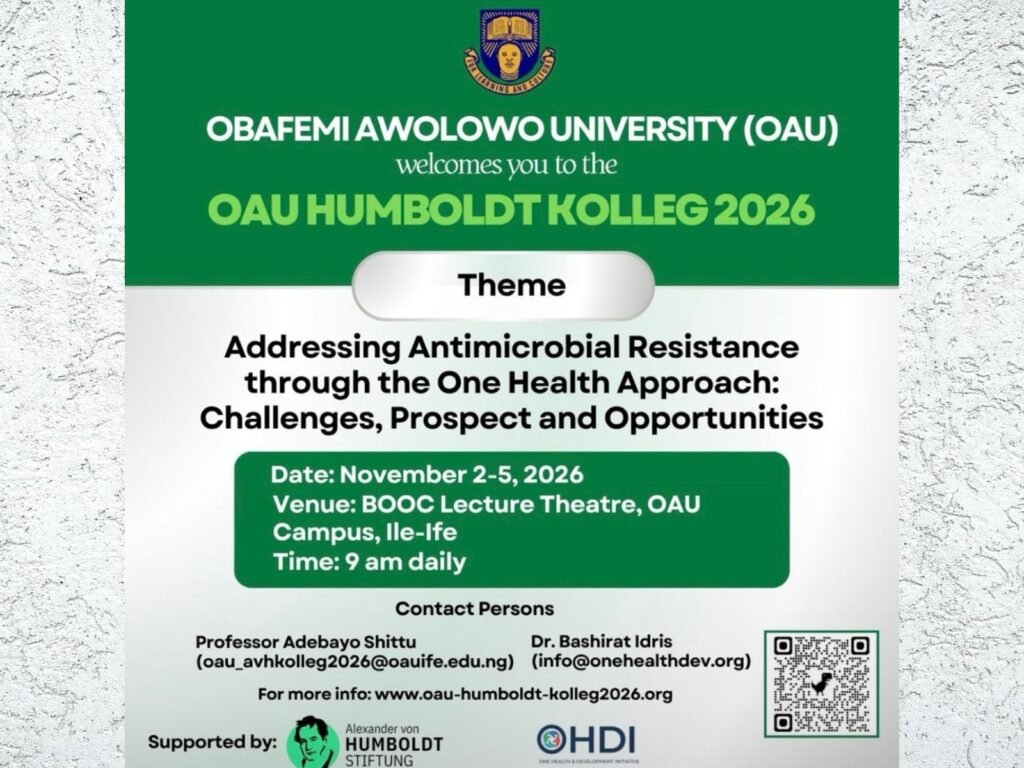
The OAU 2026 Humboldt Kolleg, themed “Addressing Antimicrobial Resistance (AMR) in Nigeria through the One Health Approach: Challenges, Prospects, and Opportunities,” is organised by Professor Adebayo Osagie Shittu of the Department of Microbiology, Obafemi Awolowo University, with support from the Alexander von Humboldt Foundation and the One Health and Development Initiative.
Where: Biological Sciences Lecture Theatre C (BOOC), Obafemi Awolowo University, Ile-Ife, Nigeria
When: 2–5 November 2026
The Kolleg will bring together researchers, clinicians, veterinarians, plant health scientists, environmental scientists, policymakers, civil society organisations, youth hubs, digital health experts, media professionals, industry partners, and development partners; all working toward one shared goal: a resistance-free future for Nigeria.
Nigeria’s Progress – and the Gaps That Remain
Nigeria has already taken a bold step forward with its National Action Plan on Antimicrobial Resistance (NAP 2.0), developed using the One Health approach. It’s a strong foundation but turning policy into practice is where the real work lies.
Persistent challenges continue to slow progress, including:
- Suboptimal health financing and inconsistent funding
- Limited political commitment and cross-sector collaboration
- Gaps in integrated, comprehensive AMR surveillance
- Inadequate laboratory capacity, trained personnel, and data integration
- Uneven antimicrobial stewardship across sectors
While AMR-related and policy-relevant research continues at OAU and other Nigerian institutions, stronger knowledge translation is still needed to ensure these research studies meaningfully contribute to NAP 2.0’s implementation. The Kolleg is designed to help close that gap.
What Will Be Discussed at the Kolleg?
Over three days of keynote lectures, plenary sessions, technical presentations, poster showcases, and panel discussions, participants will explore submitted research and dialogue across ten sub-themes, including:
- Surveillance, diagnostics, and antimicrobial stewardship
- One Health policy and governance
- AMR-One Health nexus and youth engagement
- Indigenous knowledge and traditional practices
- Plant health, food safety, and AMR
- Environmental health and waste management
- Economics of AMR mitigation and stewardship
- AMR education and science communication
- Community engagement, risk communication, and behaviour change
- Artificial intelligence and data science
The goal isn’t just conversation, it’s connecting research evidence to real policy and practice, so Nigeria’s response to AMR becomes sharper, faster, and more sustainable.
OHDI’s Contribution: Expertise and Youth Leadership
As a committed partner in this effort, OHDI is supporting Obafemi Awolowo University’s Local Organizing Committee (LOC) with programme design, session coordination, and technical advisory support. OHDI is also contributing its expertise in AMR, One Health systems, stakeholder engagement, research, advocacy, and youth participation to strengthen the Kolleg’s sessions and outcomes.
Dr Kikiope Oluwarore, Executive Director of One Health and Development Initiative, will deliver a keynote lecture titled “Strengthening One Health Systems for Sustainable AMR Control.”
Damilola Adesuyi, OHDI’s AMR Program Coordinator will facilitate the youth-focused panel discussion, themed “AMR-One Health Nexus and Youth Engagement”., with panelists from various organizations, and Dr Samuel Akpan, OHDI’s Research, Policy & Strategy Manager. This session will spotlight the critical role young people play in the AMR response now and in sustaining AMR mitigation across generations, and how the pipeline of the future AMR workforce can be strengthened.
From Dialogue to Real-World Impact
The true measure of this Kolleg won’t be the discussions alone, it will be what happens next. Expected outcomes include:
- Stronger connections between research, policy, and practice
- Deeper collaboration across human, animal, plant, and environmental health sectors
- Greater youth participation in shaping AMR solutions
- Fresh, innovative approaches to surveillance, stewardship, and AMR risk communication
Recommendations from the Kolleg will be compiled into a formal communique and shared with relevant government ministries, agencies, civil society organisations, development partners, and media, ensuring the conversation translates into measurable change.
Be Part of Nigeria’s One Health Movement
Antimicrobial resistance is a shared threat and defeating it requires shared action. Whether you’re a researcher, policymaker, healthcare worker, veterinarian, environmental expert, young advocate, or simply someone who cares about the future of public health in Nigeria, your voice belongs in this conversation.
OHDI is honoured to stand alongside Obafemi Awolowo University, the Alexander von Humboldt Foundation, and fellow stakeholders in strengthening Nigeria’s One Health approach to antimicrobial resistance, turning knowledge and collaboration into meaningful action.