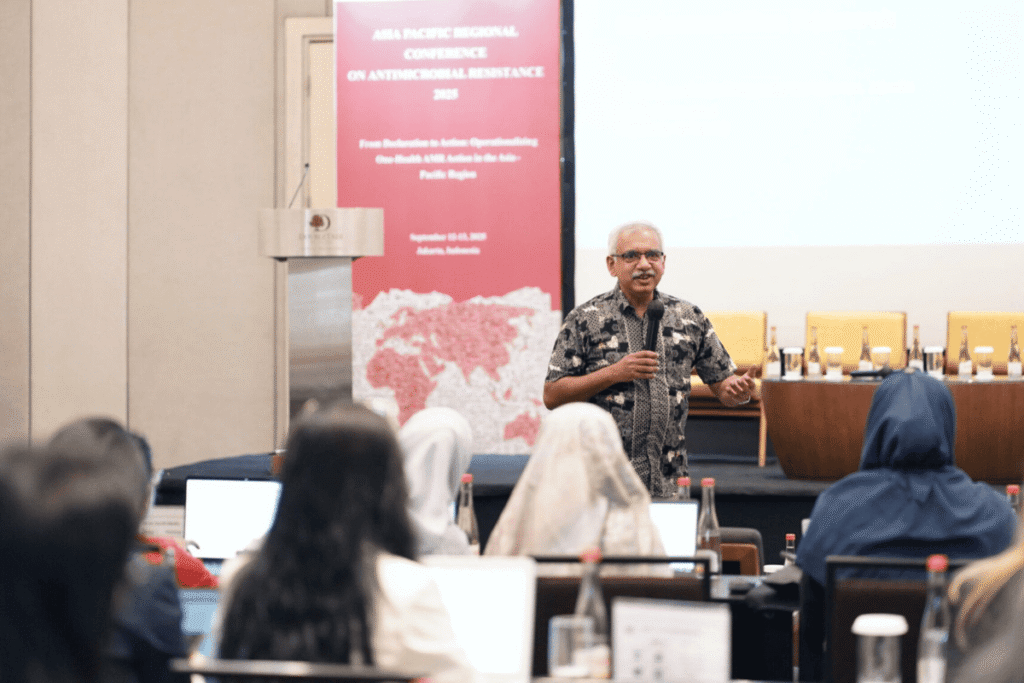
As antimicrobial resistance (AMR) continues to pose a growing threat across human, animal, and environmental health systems, the question of how AMR interventions can achieve lasting impact remains critical, particularly in low- and middle-income countries (LMICs). Building on earlier engagements in Africa, the ICARS Sustainable Impact and AMR project brought this conversation to the Asia-Pacific region during the ReAct Asia Pacific Conference 2025, held in Jakarta, Indonesia.
Ahead of the main conference, ICARS convened a Sustainable Impact and AMR Consultative Focus Group Discussion (FGD) as a dedicated side session. The two-hour session brought together project implementers, researchers, and policymakers from across Asia to reflect on what sustainable impact in AMR truly means in practice, why it often fails to materialize, and what can be done differently.
Purpose of the Consultative Session
The ReAct Asia consultative session was not intended to present findings or conclusions, but rather to listen, learn, and test ideas emerging from earlier phases of the project. Specifically, the engagement aimed to:
- Explore how AMR practitioners and policymakers in Asia conceptualize “sustainable impact”
- Understand the practical realities of implementing and sustaining AMR interventions across sectors
- Gather contextual perspectives to inform the refinement of the Sustainable Impact Resource Guide and Toolkit under development
- Ensure that the project’s outputs are globally relevant, context-sensitive, and grounded in real-world implementation experiences
A Diverse Regional Dialogue
Participants represented a broad range of countries and One Health sectors, including human, animal, and environmental health, as well as aquaculture. This diversity was intentional, reflecting the project’s One Health orientation and the understanding that sustainable AMR action depends on coordinated, multisectoral engagement across systems and actors.
The mix of government institutions, academic researchers, civil society organizations, and implementing partners enriched the discussions, bringing together varied perspectives on what it takes to sustain AMR interventions in different contexts. Facilitated group work allowed participants to explore sustainability from multiple angles, including policy alignment, financing, community ownership, systems strengthening, and behaviour change.
Interactive methods such as legacy mapping, barrier-busting exercises, and “what works/what if” reflections created space for open dialogue. Participants were encouraged to share experiences, question assumptions, and surface practical challenges and opportunities, without pressure to reach consensus or produce formal recommendations. This approach helped capture both shared regional themes and sector-specific realities shaping sustainable AMR action.
Contributing to a Growing Evidence Base
Insights from the ReAct Asia engagement form part of a broader, iterative learning process within the ICARS Sustainable Impact and AMR project. Together with earlier consultative workshops in Africa, systematic literature reviews, and global surveys, this session helps ensure that the evolving framework and toolkit are shaped by diverse regions, disciplines, and real-world implementation experiences.
Rather than focusing on extracting standalone results, the project team is synthesizing cross-cutting patterns, tensions, and lessons that emerge across contexts. These insights will inform subsequent stages of analysis, refinement, and publication.
Contributions from the ReAct Asia consultative session will feed directly into the ICARS Sustainable Impact Resource Guide and Toolkit, complementing evidence generated from Africa-focused engagements and global research activities. Participants also highlighted the importance of sharing synthesized outputs back with country teams and policymakers to support continued learning, reflection, and action beyond the workshop.
What Comes Next
Perspectives gathered during the ReAct Asia engagement will be carefully integrated into the next phase of the project, which focuses on refining practical guidance, tools, and frameworks that AMR project teams can apply across the project lifecycle, from design and implementation to monitoring, transition, and continuity. This engagement reinforced an important insight emerging across regions which is that implementation contexts vary, but many of the underlying drivers, constraints, and pathways to sustainable AMR impact are shared. Grounding global frameworks in regional and country-level realities remains central to the project’s approach, ensuring that the final Resource Guide and Toolkit are both adaptable and relevant.
Further updates on the ICARS Sustainable Impact and AMR project, including how insights from regional engagements are shaping the evolving framework, guidance, and tools, will be shared in the coming months as cross-regional synthesis and refinement continue.
This engagement was supported by the International Centre for Antimicrobial Resistance Solutions (ICARS), with funding from the Wellcome Trust, and implemented in collaboration with project partners across regions.