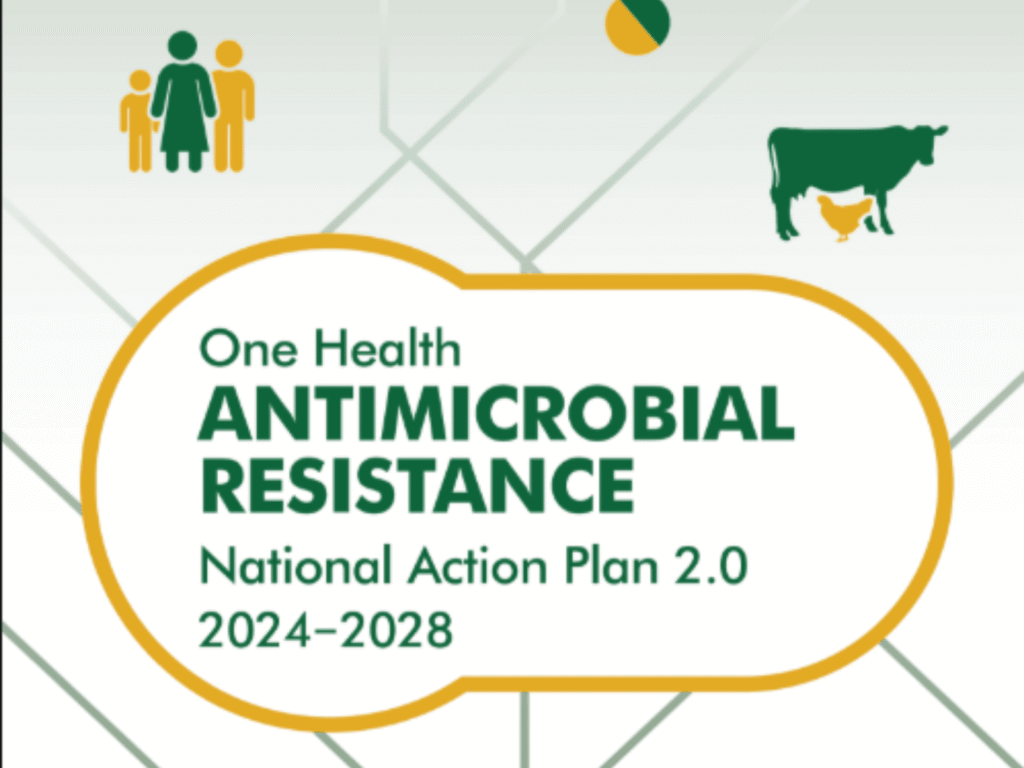
The One Health and Development Initiative (OHDI) proudly joins the Government of Nigeria and national stakeholders in celebrating the launch of Nigeria’s National Action Plan on Antimicrobial Resistance (NAP-AMR) 2.0, a renewed national commitment to addressing one of the most pressing public health, food security, and development challenges of our time.
Building on the foundations of the first National Action Plan, NAP-AMR 2.0 reflects Nigeria’s evolving understanding of antimicrobial resistance as a complex, multisectoral challenge that requires coordinated action across human health, animal health, agriculture, and the environment, guided by a One Health approach.
Strengthening Evidence-Informed and Coordinated Action
The development of NAP-AMR 2.0 was informed by extensive stakeholder engagement, situational analyses, and lessons learned from the implementation of the first NAP. It places renewed emphasis on governance, coordination, surveillance, stewardship, awareness, research, and sustainable implementation, while recognising the importance of subnational action and institutional ownership.
OHDI welcomes this strengthened focus and recognises the NAP 2.0 as a critical framework for aligning national priorities, mobilising partners, and translating policy commitments into practical action.
OHDI also acknowledges the contribution of Dr. Kikiope Oluwarore, Founder and Executive Director of OHDI, to the development of Nigeria’s NAP-AMR 2.0. Through her work in AMR research, policy analysis, One Health coordination, and stakeholder engagement, Dr. Oluwarore contributed technical inputs that supported evidence-informed decision-making and strengthened the One Health framing of the national response. Her contribution reflects OHDI’s long-standing engagement with Nigeria’s AMR ecosystem, including work on AMR situational analyses, policy evaluations, prioritisation processes, curriculum and capacity assessments, and implementation-focused research.
OHDI’s Commitment to Implementation and Learning
As Nigeria transitions from policy development to implementation, OHDI reaffirms its commitment to working alongside government institutions, civil society, academia, professional bodies, and development partners to support the effective delivery of NAP-AMR 2.0.
OHDI’s support will continue to focus on:
- Research and evidence generation to inform adaptive implementation
- Policy support and technical assistance for One Health coordination and governance
- Capacity strengthening across professional groups and institutions
- Monitoring, evaluation, accountability, and learning (MEAL) to support sustainable impact
- Stakeholder engagement and knowledge translation to bridge policy and practice
We believe that the success of NAP-AMR 2.0 will depend not only on strong national leadership, but also on inclusive partnerships, sustained investment, and continuous learning across sectors and levels of governance.
Looking Ahead
The launch of Nigeria’s NAP-AMR 2.0 represents a renewed opportunity to strengthen the country’s response to antimicrobial resistance in a way that protects public health, safeguards food systems, and supports environmental sustainability.
OHDI is proud to stand with national stakeholders in advancing this agenda and remains committed to contributing its expertise, partnerships, and evidence to support the successful implementation of Nigeria’s One Health vision for AMR.
Read and Download the Action Plan here.