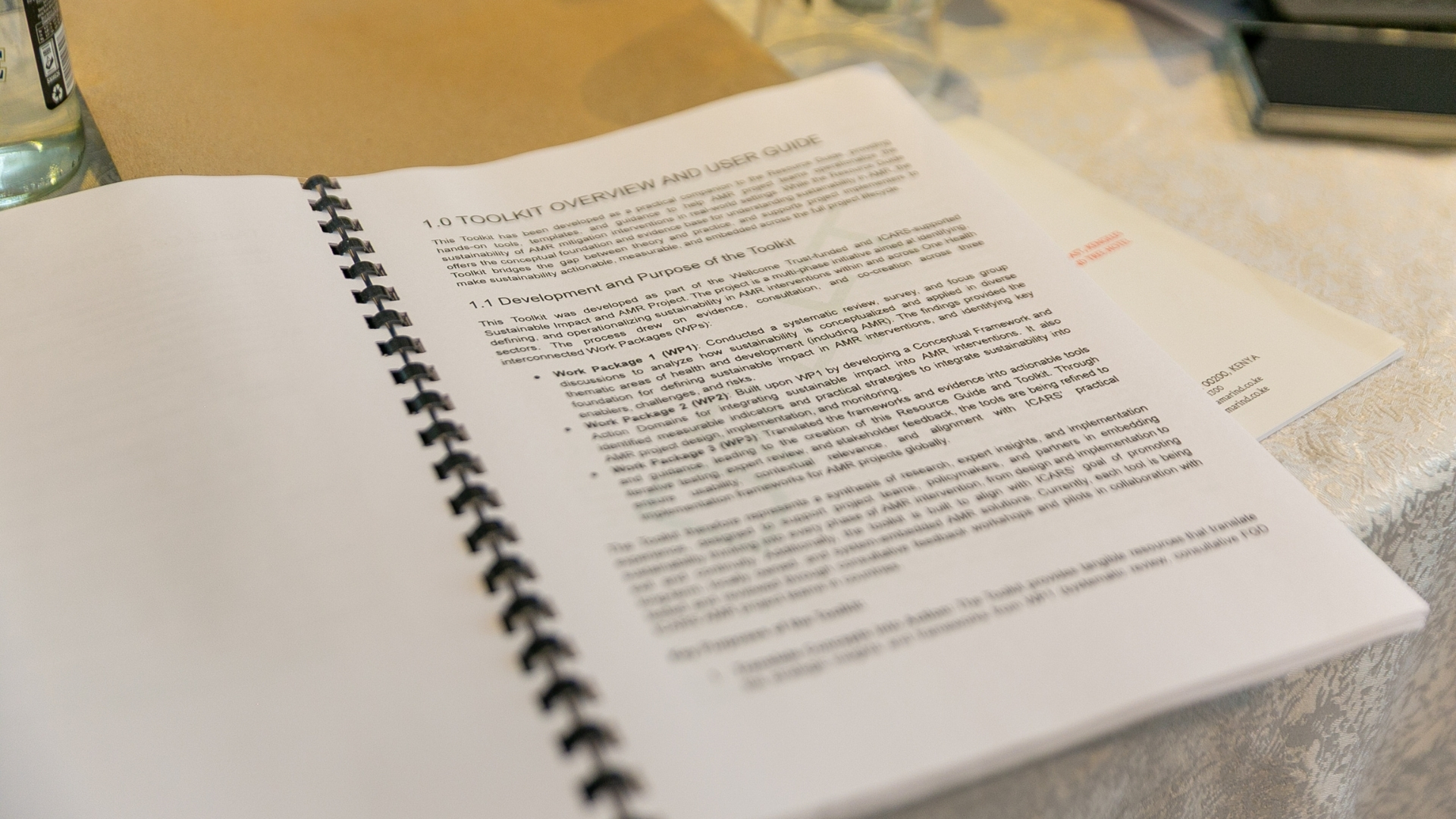
After months of research, consultation, and collaborative learning, the ICARS Sustainable Impact and Antimicrobial Resistance (AMR) project has reached a major milestone: the development of the draft Sustainable Impact Resource Guide and Toolkit. This draft marks the point where evidence, experience, and practice come together, transforming insights from research into practical guidance that AMR project teams can actually use.
Bringing Together Multiple Streams of Evidence
The draft Resource Guide and Toolkit draw on the full body of work conducted under Work Package 1 (WP1) and Work Package 2 (WP2).
- WP1 focused on understanding how sustainable impact is defined, framed, and discussed across AMR and related fields, through a systematic review and global consultations.
- WP2 examined how sustainability is operationalized in practice, looking at approaches used across AMR interventions to embed sustainability during project design, implementation, monitoring, and transition.
Rather than treating these work packages as separate exercises, the project deliberately adopted a data triangulation and evidence synthesis approach, bringing together findings from literature reviews, surveys, regional workshops, and practitioner engagements. This allowed the team to compare perspectives, identify converging themes, and surface areas of tension or inconsistency across different contexts.
Why Data Triangulation Matters
Sustainability in AMR is complex and context-dependent. No single data source can capture this complexity on its own. Therefore, by triangulating evidence from multiple sources, the project team was able to:
- Validate recurring sustainability concepts and patterns across regions and sectors
- Identify practical enablers and barriers that cut across project types
- Ensure that the emerging guidance reflects both academic evidence and real-world implementation realities
This approach strengthens the credibility of the Resource Guide and Toolkit, while ensuring they remain grounded, adaptable, and relevant, particularly for AMR projects in low- and middle-income countries.
From Concepts to Practical Tools
The result of this synthesis process is a practice-oriented Resource Guide accompanied by a structured Toolkit designed to help AMR project teams integrate sustainability thinking from project design onward; navigate sustainability during implementation and adaptive management; strengthen ownership, institutionalization, and learning; and plan more intentionally for transition, scale, or exit
Importantly, the draft versions are not presented as “final answers.” Instead, they are designed as living resources to be tested, refined, and improved through continued engagement with AMR practitioners, policymakers, and partners.
A Foundation for Co-Creation and Refinement
The development of the draft Resource Guide and Toolkit represents a transition from evidence generation to co-creation and validation. These drafts now serve as a foundation for feedback workshops, pilot use, and further refinement, ensuring that the final outputs are both evidence-based and user-centered. By anchoring guidance in systematically synthesized evidence, while remaining open to adaptation and learning, the ICARS Sustainable Impact and AMR project continues to move toward its central goal which is to support AMR initiatives to shift from short-term interventions to durable, system-strengthening impact.
Further updates will be shared as the Resource Guide and Toolkit are refined through testing and stakeholder feedback across regions.