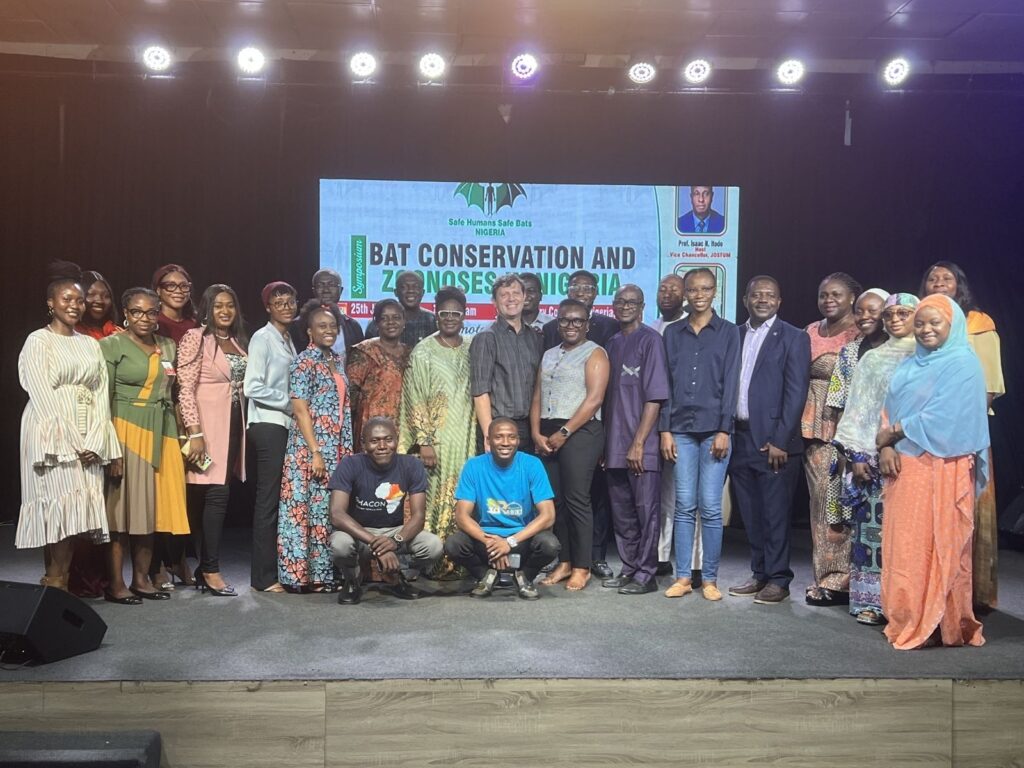
On June 25, 2025, the One Health and Development Initiative (OHDI) was represented by Dr. Abdullah Al-Awal at the “Safe Humans, Safe Bats” Symposium, held at the Veterinary Council of Nigeria. The symposium brought together a diverse group of stakeholders spanning public health, wildlife conservation, academia, and development sectors to explore one of the most critical yet often misunderstood intersections in global health – the relationship between humans and bats.
Organized under the leadership of Dr. Efstathios Giotis of the University of Essex, and supported by leading institutions including the Bat Conservation Trust, Joseph Sarwuan Tarka University, SMACON, and the War Against Rabies Foundation, the initiative reflects a growing recognition of the need to address zoonotic risks through integrated, science-driven, and community-centered approaches.
Why This Conversation Matters
The symposium was anchored in the fact that protecting human health and conserving wildlife are not opposing goals, rather they are deeply interconnected.
Bats, often feared due to their association with diseases such as Ebola, rabies, and Nipah virus, play essential ecological roles, including pollination, seed dispersal, and pest control. Yet, increasing habitat destruction, urban expansion, and changing human behaviors are bringing bats and humans into closer contact, raising the risk of zoonotic spillover events.
This intersection is precisely where the One Health approach becomes indispensable, and where OHDI’s work is most relevant.
High-Level Commitment to One Health and Zoonotic Preparedness
The symposium featured keynote addresses from leading figures in Nigeria’s health and livestock sectors, reflecting a strong national commitment to addressing zoonotic risks.
The Honourable Coordinating Minister of Health and Social Welfare, Prof. Muhammad Ali Pate, emphasized the urgent need to integrate wildlife surveillance into existing public health systems. He highlighted that future preparedness will depend on stronger early warning systems, community engagement, and transdisciplinary collaboration, all rooted in a One Health framework.
Similarly, the Honourable Minister of Livestock Development underscored the ecological importance of bats, cautioning against viewing them solely as disease vectors. He drew attention to how environmental degradation, deforestation, and unregulated practices are increasing human–wildlife interaction and, consequently, the risk of disease emergence.
These messages align closely with OHDI’s strategic direction, particularly the development of community-based models like CD-PRES that strengthen prevention, surveillance, and response at the human–animal–environment interface.
From Science to Community Realities
One of the most compelling aspects of the symposium was the grounding of high-level discussions in real-world evidence and field experiences.
Presentations during the technical sessions highlighted how cultural practices, economic realities, and knowledge gaps continue to drive risky interactions between humans and bats. In some communities, bat hunting persists as a source of food or income, often without awareness of the associated health risks.
Other discussions revealed how zoonotic threats are no longer confined to rural or wildlife settings. Cases of rabies linked to indirect exposure pathways illustrate how disease transmission can occur within domestic environments, underscoring the need for integrated surveillance and prevention systems that extend beyond traditional boundaries.
Equally important was the emphasis on ecological drivers of disease emergence. Habitat destruction, wildfires, and urban expansion are displacing bat populations, increasing their proximity to human settlements. This reinforces the need to integrate environmental protection into public health strategies, rather than treating them as separate domains.
Rethinking Conservation as a Public Health Strategy
A central theme throughout the symposium was the need to reshape narratives around bats and wildlife more broadly.
Dr. Iroro Tanshi, a leading bat ecologist and conservationist, delivered a powerful message that reframed conservation as a direct investment in human health. Her call to “see conservation not as a luxury, but as a public health necessity” captured the essence of the discussions and highlighted the importance of community-driven solutions.
This perspective is critical. Effective disease prevention cannot rely solely on clinical interventions or surveillance systems. It must also address the environmental and behavioral drivers that create conditions for disease emergence in the first place.
Opportunities for Collaboration and Next Steps
The symposium also created space for identifying practical pathways for collaboration.
Key opportunities discussed included:
- Community-based conservation surveillance and risk communication
- Youth and school-based education programs to reshape perceptions and behaviors
- Strengthening partnerships between government, academia, and civil society
These areas strongly align with OHDI’s ongoing and emerging initiatives, particularly in community engagement, risk communication, and integrated surveillance systems.
Positioning OHDI Within the One Health Ecosystem
OHDI’s participation in the symposium reinforces its role as a bridge between community-level realities and broader health security systems.
Through initiatives like CD-PRES, OHDI is actively working to strengthen community-based early warning and reporting systems, promote behavior change and risk reduction practices, integrate human, animal, and environmental health approaches and leverage digital tools to improve continuity, communication, and surveillance
The insights gained from the symposium will directly inform how these models are refined and scaled, ensuring they remain grounded in both scientific evidence and community realities.
Looking Ahead
As global attention increasingly shifts from response to resilience, it is clear that future pandemic preparedness will depend on how well we understand and manage the human–animal–environment interface.
Events like the “Safe Humans, Safe Bats” Symposium highlight both the complexity of this challenge and the opportunity to address it through integrated, collaborative, and community-driven approaches. For OHDI, this is a call to action.
Strengthening health security begins at the community level, and building resilience requires that we protect not only human health, but the ecosystems that sustain it.