Rabies is a preventable zoonotic disease that continues to threaten human and animal health, particularly in communities with limited access to veterinary services, vaccination, public health information and timely medical care. Despite the availability of effective preventive measures, eliminating dog-mediated human rabies requires sustained commitment, collective responsibility and coordinated action across sectors and communities.
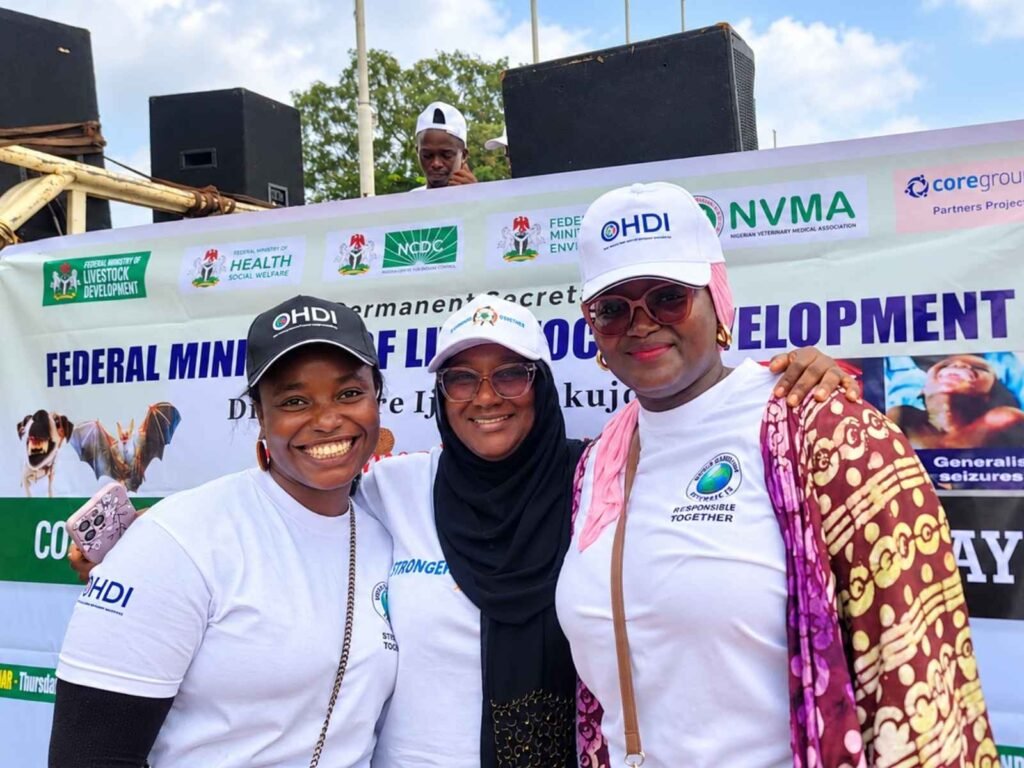
In commemoration of World Rabies Day 2026, observed annually on 28 September, the One Health and Development Initiative (OHDI) joined government institutions, professional associations, development partners and civil society organisations in a public awareness road walk held on 25 September 2026 in Abuja, Nigeria.
Organised around the theme “Stronger Together,” the awareness campaign brought stakeholders together to promote rabies prevention and control, encourage responsible dog ownership and reinforce collective commitment towards achieving zero human deaths from dog-mediated rabies by 2030.
OHDI was represented by Dr. Bashirat Idris, Program and Communications Coordinator, and Dr. Titilayo Ayodele, who joined other stakeholders in taking important rabies prevention messages directly to the public.
Taking Rabies Prevention Messages to the Streets
Public awareness is a fundamental component of effective rabies prevention. While vaccination, disease surveillance and access to healthcare remain critical, their effectiveness also depends on what people know, how they perceive disease risks and the actions they take to protect themselves, their families and their animals.
The awareness road walk provided an opportunity to take rabies prevention messages beyond institutional and professional spaces and directly into public spaces across the Federal Capital Territory (FCT).

Participating institutions and organisations included the Federal Ministry of Livestock Development, Federal Ministry of Health and Social Welfare, Federal Ministry of Environment, Nigeria Centre for Disease Control and Prevention (NCDC), Nigerian Veterinary Medical Association (NVMA), CORE Group, War Against Rabies Foundation (WARF), OHDI and other relevant stakeholders.
Through the collective mobilisation of professionals and institutions across the human, animal and environmental health sectors, the campaign reinforced the importance of a coordinated One Health approach to rabies prevention and control.
The road walk formed part of broader activities planned for World Rabies Day 2026 in Nigeria, including mass anti-rabies vaccination, community sensitisation, a technical symposium and wider national mobilisation.
Stronger Together: Why Rabies Elimination Requires Collective Action
The 2026 World Rabies Day theme, “Stronger Together,” reflects a fundamental principle of One Health: interconnected health challenges cannot be effectively addressed by individual sectors or institutions working in isolation.
Rabies prevention requires coordinated responsibilities across multiple stakeholders.
Veterinary professionals play a critical role in animal vaccination, disease surveillance, responsible animal ownership education and the investigation of suspected animal rabies cases. Healthcare professionals are essential in providing appropriate medical care following exposure, while public health authorities coordinate surveillance, disease reporting, risk communication and response.
Government institutions are responsible for creating enabling policies, mobilising resources and strengthening the systems needed for effective prevention and control. Civil society organisations and development partners can complement these efforts through community engagement, advocacy, research, capacity strengthening and programme implementation.
Communities themselves are equally important. Dog owners, families, schools and community leaders all have a role in promoting responsible animal ownership, preventing animal bites, recognising potential disease risks and encouraging timely reporting and healthcare-seeking behaviour.
By connecting these responsibilities, a One Health approach creates a more comprehensive and sustainable pathway towards rabies elimination.
Responsible Dog Ownership and Vaccination: Preventing Rabies at Its Source
Preventing rabies begins with protecting animals and reducing the risk of transmission to humans.

Responsible dog ownership goes beyond providing food and shelter. It involves ensuring that dogs receive appropriate vaccination, regular veterinary care, humane treatment and proper supervision.
Mass dog vaccination remains a fundamental strategy for preventing dog-mediated human rabies. Improving vaccination coverage requires accessible and affordable veterinary services, sustained public awareness, community participation and effective coordination between relevant authorities.
Promoting responsible dog ownership also requires addressing misconceptions about rabies, encouraging positive human-animal interactions and supporting humane approaches to dog population management.
Importantly, protecting public health should go hand in hand with protecting animal health and welfare. Humane, evidence-based approaches to rabies prevention can contribute to safer communities while improving the lives of animals.
What Everyone Can Do to Prevent Rabies
Achieving a rabies-free future requires individuals and communities to take practical preventive actions.
Everyone can contribute to rabies prevention by:
- Ensuring that dogs and other susceptible pets receive appropriate rabies vaccination in accordance with veterinary recommendations.
- Practising responsible and humane animal ownership.
- Teaching children how to interact safely with dogs and other animals.
- Avoiding unnecessary contact with unfamiliar animals or animals displaying unusual behaviour.
- Reporting suspected rabies cases, unusual animal behaviour and potential exposures to relevant veterinary and public health authorities.
- Seeking immediate medical attention following a potentially rabies-exposing animal bite, scratch or contact.
- Sharing accurate rabies prevention information within families, schools, workplaces and communities.
Public awareness must translate into informed decisions and preventive behaviours that reduce disease risks and protect both people and animals.
Moving Beyond World Rabies Day Towards Sustained Prevention
World Rabies Day provides an important opportunity to mobilise stakeholders, raise awareness and renew commitments towards rabies elimination. However, achieving lasting results requires sustained action throughout the year.
Community awareness campaigns must be complemented by functional disease surveillance systems, accessible vaccination services, timely post-exposure care, effective reporting mechanisms and continued investment in veterinary and public health infrastructure.
Particular attention must also be given to underserved and hard-to-reach communities, where limited access to preventive services and reliable health information can increase vulnerability to rabies.
Strengthening community-level engagement, improving access to trusted health information and connecting communities with veterinary and healthcare services are essential to ensuring that rabies prevention efforts reach those who need them most.
The global goal of zero human deaths from dog-mediated rabies by 2030 presents an opportunity for countries, institutions and communities to accelerate collective efforts towards eliminating preventable human deaths.
OHDI’s Commitment to Rabies Prevention and One Health
OHDI’s participation in the World Rabies Day 2026 awareness campaign reflects our broader commitment to zoonotic disease prevention, health security, animal welfare, community engagement and the operationalisation of One Health.
At OHDI, we recognise that effective disease prevention requires more than technical interventions. It requires informed and empowered communities, accessible health services, strong institutional collaboration and sustained efforts to promote preventive health behaviours.
We remain committed to working with government institutions, veterinary and healthcare professionals, development partners, civil society organisations and communities to strengthen zoonotic disease prevention, public awareness, surveillance and coordinated One Health action.
OHDI commends all participating institutions, organisations and professionals for coming together to amplify rabies prevention messages and renew collective commitment towards eliminating dog-mediated human rabies deaths.
As we reflect on the message of World Rabies Day 2026, we are reminded that every vaccination, every informed decision, every reported suspected case and every collaborative effort brings us closer to a future where no person dies from dog-mediated rabies.
Rabies is preventable. Every life matters. And together, we can end dog-mediated human rabies deaths.